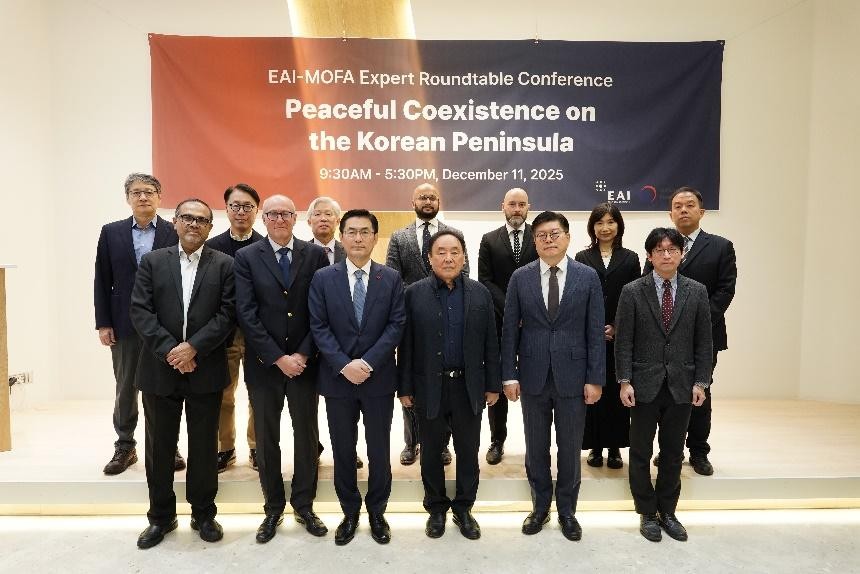
EAI, in collaboration with the Ministry of Foreign Affairs (MOFA), hosted a closed-door roundtable conference with international experts on the theme of "Peaceful Coexistence on the Korean Peninsula." This event featured a distinguished group of domestic and international experts—including T. V. Paul, Robert Ross, Minghao Zhao, Kyoko Hatakeyama, Eric Ballbach, and Ankit Panda—who engaged in in-depth discussions on the emergence of the "Trump 2.0" era and survival strategies for the Korean Peninsula within a "multiplex-multipolar order". Through this conference, EAI aimed to present realistic policy alternatives for risk management and "stable coexistence" alongside the long-term goal of denuclearization, while exploring a new architecture for multilateral security cooperation.
T. V. Paul, ① The New Cold War and Changing Global and Regional Orders [Watch Video]
Robert S. Ross, ② China's Rise, America's Decline, and South Korea's Strategic Dilemma [Watch Video]
Minghao Zhao, ③ The Great-Power Rivalry, Regional Security and Peace on the Korean Peninsula [Watch Video]
Kyoko Hatakeyama,④ A Pragmatic Multilateral Approach: ROK-U.S.-Japan as First Step for Stability [Watch Video]
Eric J. Ballbach, ⑤ On the Challenges of Re-Engaging North Korea: A View from Europe [Watch Video]
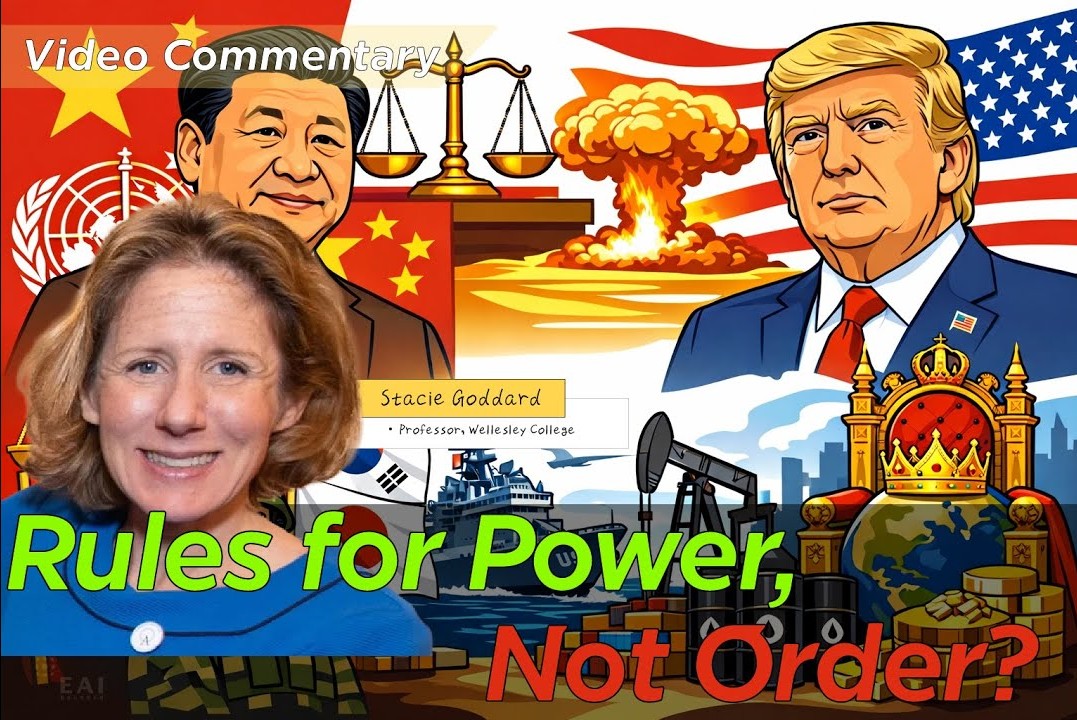
[Video Commentary] China, Trump and the Future of Global Order
Stacie Goddard (Professor, Wellesley College) discusses China’s strategic use of legitimation, the changing logic of U.S. foreign policy under Trump, the idea of “neo-royalism” as a new framework, and the future of global order. She also points ahead to pressing questions for U.S. allies—especially in East Asia—about alliance commitments, multipolar stability, and the growing role of economic and resource politics.